
 Deutsch
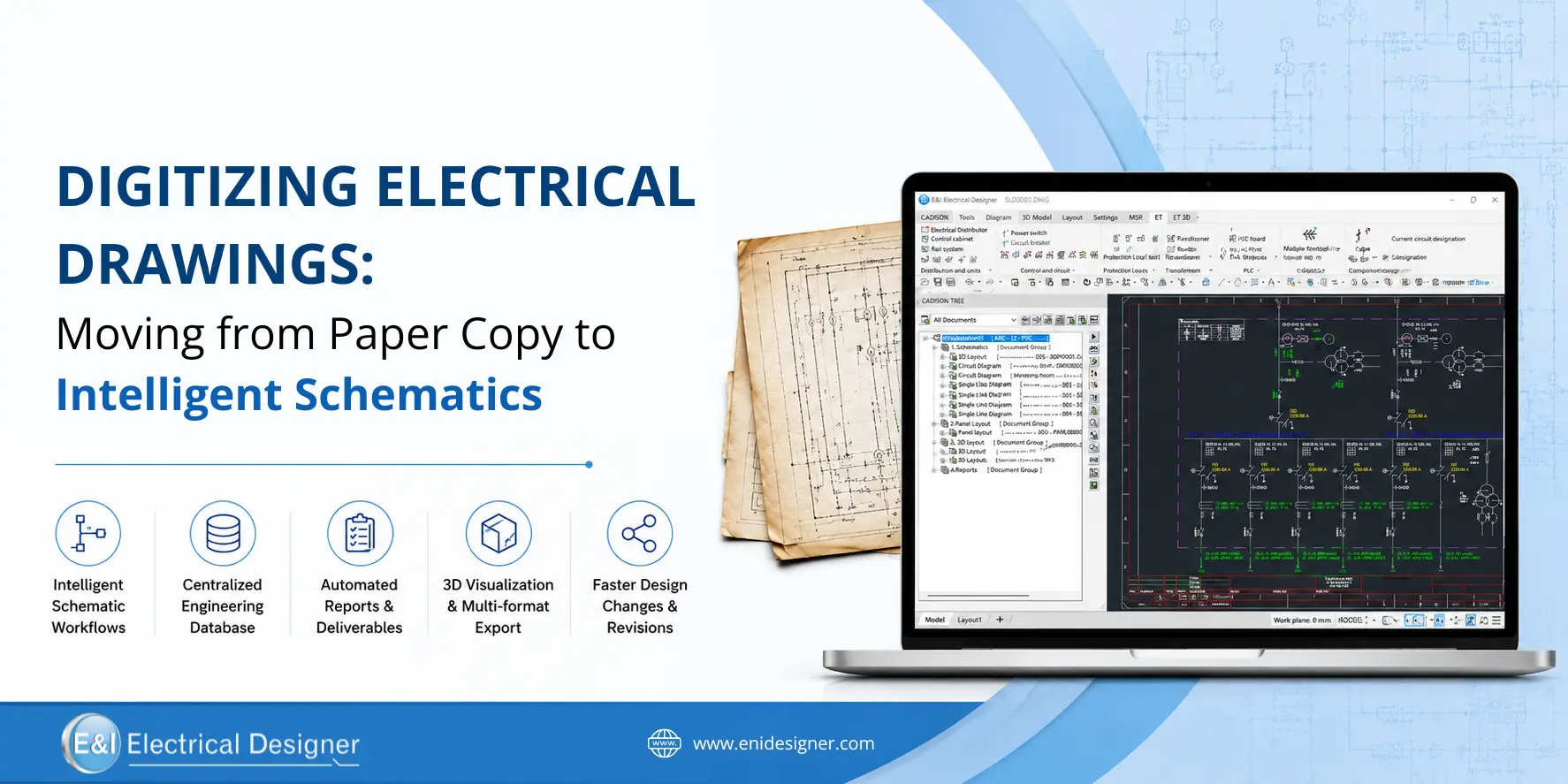
 Digitizing Electrical Drawings: Moving From Paper Copies to Intelligent Schematics
Industrial facilities, EPC companies, and manufacturing plants often manage large volumes of legacy electrical documentation in the form of paper copies, scanned drawings, PDFs, and older drafting files. While these documents contain critical engineering information, maintaining and updating them through traditional workflows can become time-consuming and difficult as projects evolve.
Engineering teams frequently spend valuable time recreating schematics, updating revisions manually, maintaining numbering consistency, and generating engineering reports across multiple drawings. As industrial projects become more complex, disconnected drafting workflows can affect productivity, design consistency, and project timelines.
Modern intelligent schematic workflows help organizations transform traditional electrical documentation into editable, standardized, and connected engineering environments that improve efficiency and simplify engineering management.
Challenges with Traditional Electrical Documentation
Many engineering organizations still rely on paper-based drawings, scanned schematics, and static PDF documentation. Although these files preserve historical engineering information, they create several operational limitations during modernization projects and future expansions.
Updating existing drawings often requires engineers to manually recreate schematic information, symbols, and references. Even small engineering changes may require modifications across multiple interconnected drawings, increasing both engineering effort and revision complexity.
Engineering teams also spend considerable time creating title blocks, legend sheets, and repetitive schematic layouts manually. Without reusable engineering structures, the same drafting tasks are repeated across multiple projects.
Managing device references manually across hundreds of schematics can also lead to inconsistent numbering, duplicate references, and increased verification effort. As projects scale, maintaining documentation consistency becomes increasingly challenging.
Moving Toward Intelligent Schematic Workflows
Modern intelligent electrical design approaches help organizations move beyond disconnected drafting workflows by creating centralized and editable schematic environments.
Instead of working with static drawings, engineering teams can manage connected engineering data that supports intelligent schematic creation, reusable engineering structures, automated numbering, simplified revisions, and faster design modifications.
Reusable engineering templates and construction-based workflows help reduce repetitive drafting effort while improving project standardization and engineering consistency. Teams can also reuse validated engineering data across projects, helping accelerate project execution and reduce manual engineering activities.
Automated Tagging, Revisions, and Design Management
Manual device identification is one of the most time-consuming aspects of traditional electrical drafting workflows. Intelligent schematic environments support automated device tagging, component numbering, and cross-referencing, helping improve documentation consistency while reducing manual checking efforts.
Connected schematic workflows also simplify engineering change management by maintaining relationships between engineering data and associated documentation across multiple schematics. This improves revision control, design consistency, and overall engineering coordination throughout the project lifecycle.
Automated Reports and Deliverables
Traditional engineering workflows often require teams to manually prepare project deliverables during different stages of engineering and construction.
Modern intelligent schematic workflows help automate deliverables such as Bills of Materials (BOM), Load Lists, Cable Lists, Cable Tray Lists, Terminal Lists, and Wiring Lists. Automated report generation improves engineering consistency while significantly reducing repetitive documentation effort.
Engineering deliverables can also be exported in formats such as DWG, PDF, 3D PDF, and GLTF, improving collaboration, accessibility, and engineering visualization across different project environments.
Benefits of Intelligent Electrical Design Workflows
Organizations modernizing legacy electrical documentation can improve engineering productivity, reduce repetitive drafting effort, simplify revision management, and maintain better documentation consistency across projects.
By adopting intelligent schematic workflows, engineering teams can accelerate project execution, improve engineering accuracy, and simplify long-term project maintenance while maintaining standardized engineering practices.
Conclusion
As industrial engineering projects continue to evolve, traditional drafting methods and disconnected documentation workflows are becoming increasingly difficult to manage efficiently.
Intelligent schematic workflows help organizations modernize legacy electrical drawings through reusable engineering data, automated tagging and numbering, simplified revision management, automated report generation, and flexible deliverable workflows.
E&I Electrical Designer helps engineering organizations transform traditional electrical documentation into intelligent, editable schematic workflows that support automation, standardized engineering practices, accurate deliverables, and streamlined project execution for industrial engineering projects.